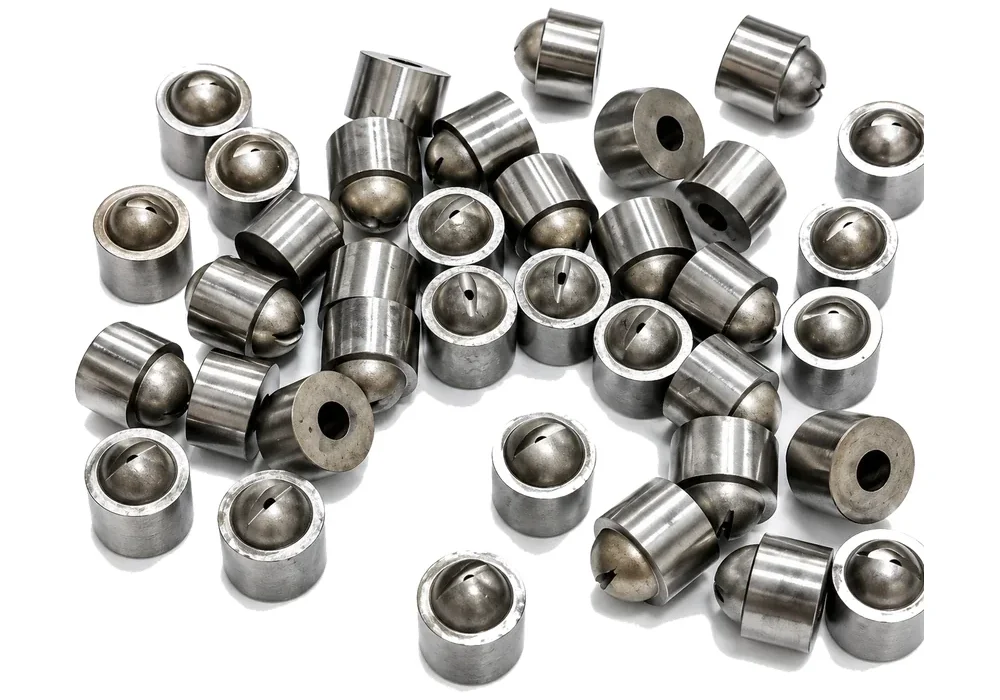
A tungsten carbide nozzle rarely fails all at once. In most applications, wear develops gradually as abrasive particles, liquid droplets, powders, or slurry continuously strike the internal bore. Over time, the orifice becomes larger, the flow pattern changes, operating efficiency declines, and material consumption may increase before any visible damage appears.
For abrasive blasting systems, thermal spray equipment, high-pressure cleaning systems, hydrocyclones, and other demanding industrial applications, maintaining the original bore geometry is essential for stable pressure, predictable flow, and consistent process performance.
Tungsten carbide is widely used in demanding nozzle applications because it provides a strong balance of hardness, compressive strength, erosion resistance, and mechanical toughness at a practical industrial cost.
This article explains where tungsten carbide nozzles are used, how carbide grade and binder selection affect performance, which design factors influence service life, and how to specify the right nozzle material for a particular operating environment.
Why Use Tungsten Carbide for Industrial Nozzles?
The internal bore of an industrial nozzle is often exposed to continuous erosive wear. Solid particles, powders, liquid droplets, or slurry are accelerated through a restricted flow path and repeatedly strike the internal surface.
Nozzle wear resistance depends on several material properties:
- Hardness, which helps resist abrasive cutting, scratching, and surface removal
- Fracture toughness, which helps reduce chipping and cracking under repeated particle impact
- Compressive strength, which supports performance under high pressure
- Corrosion resistance, which becomes important in wet, acidic, or chemically aggressive media
- Microstructural stability, which helps maintain bore geometry during long-term operation
Cemented tungsten carbide typically consists of hard tungsten carbide grains bonded together with a metallic binder, commonly cobalt or nickel.
Depending on grade composition and microstructure, cemented carbide can achieve hardness levels of approximately 88–93 HRA while retaining greater resistance to impact and mechanical shock than many monolithic technical ceramics.
Compared with other commonly used nozzle materials:
- Hardened steel and stainless steel are economical and suitable for less abrasive operating conditions, but their internal surfaces generally wear more quickly when exposed to hard particles or high-velocity slurry.
- Technical ceramics, including alumina, silicon carbide, and zirconia, can provide excellent hardness and corrosion resistance. However, some ceramic materials are more sensitive to impact, installation stress, vibration, and mechanical misalignment.
- Boron carbide provides excellent resistance to many fine abrasive media and is frequently used in demanding blasting applications. However, material cost, brittleness, and operating conditions must be considered during selection.
- Tungsten carbide provides a practical combination of wear resistance, toughness, dimensional stability, and industrial manufacturability. This balance makes it suitable for a wide range of abrasive and high-pressure nozzle applications.
The best material is not determined by hardness alone. Abrasive type, particle size, impact angle, pressure, corrosion, nozzle geometry, and equipment conditions should all be evaluated together.
Where Are Tungsten Carbide Nozzles Used?
Abrasive Blasting Nozzles
Sandblasting, grit blasting, bead blasting, and other abrasive surface-treatment processes accelerate abrasive media through a nozzle to clean, roughen, descale, or prepare a component surface.
The nozzle bore is continuously exposed to abrasive particles, and gradual enlargement can reduce blasting efficiency and change the spray profile.
Tungsten carbide is commonly used for general industrial blast nozzles because it provides a strong balance between abrasion resistance and resistance to handling damage.
Common designs include:
- Straight-bore blast nozzles
- Venturi blast nozzles
- Long-venturi nozzles
- carbide nozzle liners
- Replaceable carbide inserts
The most suitable carbide grade depends on the abrasive material, particle size, operating pressure, nozzle geometry, and expected impact conditions.
Thermal Spray and Coating Equipment
HVOF, plasma spray, flame spray, and other thermal coating processes feed metal, alloy, carbide, or ceramic powders through precision flow components.
Nozzles, powder injectors, gas components, and internal wear inserts may be exposed to:
- High-velocity powder flow
- Repeated particle erosion
- Elevated operating temperatures
- Thermal cycling
- Tight flow and dimensional requirements
Maintaining the original internal geometry is important because changes in the flow path may affect particle velocity, powder distribution, coating uniformity, and deposition efficiency.
Tungsten carbide nozzle inserts can provide improved resistance to powder erosion compared with conventional steel components in suitable applications.
Hydrocyclone and Desanding Components
Hydrocyclones are widely used in oil and gas processing, drilling-fluid treatment, mineral processing, wastewater treatment, and solids-separation systems.
Components such as apex inserts, spigots, vortex finders, and wear nozzles are exposed to continuous slurry flow containing abrasive solid particles.
As the internal diameter wears, separation performance may change because the operating geometry of the hydrocyclone is altered.
Tungsten carbide inserts are used to improve dimensional stability and extend maintenance intervals in abrasive slurry conditions.
For wet, acidic, saline, or chemically aggressive media, corrosion-resistant binder systems may be more suitable than standard cobalt-bonded carbide.
Abrasive Waterjet Mixing Tubes
In abrasive waterjet cutting, the mixing tube, also known as a focusing tube, directs and accelerates a high-velocity mixture of water and abrasive particles toward the workpiece.
The internal bore must maintain accurate geometry to support:
- Consistent jet alignment
- Stable cutting performance
- Controlled kerf width
- Predictable cutting accuracy
Tungsten carbide and specialized carbide-based materials are used in waterjet components because of their resistance to high-velocity abrasive erosion.
Material composition, bore straightness, internal surface quality, and dimensional tolerance all influence service performance.
High-Pressure Descaling and Industrial Cleaning
High-pressure water systems are used for:
- Steel descaling
- Pipeline cleaning
- Boiler-tube cleaning
- Heat-exchanger maintenance
- Surface preparation
- Industrial equipment cleaning
Even small quantities of solid contamination in the water can gradually erode the nozzle orifice.
Carbide orifice inserts may be used to help maintain the designed flow rate, pressure characteristics, and spray pattern over extended operating periods.
The required carbide grade depends on water quality, pressure conditions, particle contamination, nozzle geometry, and installation design.
Agricultural and Chemical Spray Nozzles
Agricultural spraying systems may handle fertilizers, pesticide formulations, wettable powders, and particulate suspensions.
Gradual nozzle wear can increase flow rate and alter the spray pattern, potentially affecting:
- Application uniformity
- Chemical consumption
- Coverage accuracy
- Operating cost
Carbide-tipped nozzles can be used where long-term spray accuracy and resistance to abrasive formulations are important.
Material compatibility should also be evaluated when the sprayed medium contains corrosive chemicals.
Refractory Gunning and Shotcrete Equipment
Refractory gunning and shotcrete processes transport abrasive dry mixtures, wet concrete, minerals, or refractory particles through hoses and nozzles.
These components may experience:
- Severe internal abrasion
- Impact from coarse particles
- Vibration
- Mechanical handling
- Repeated pressure changes
Carbide-lined nozzles and replaceable carbide wear inserts can help extend service intervals compared with unprotected steel components.
In these applications, toughness and edge strength may be more important than selecting the highest possible hardness.
How to Select a Tungsten Carbide Grade for Nozzles
Not all tungsten carbide grades provide the same performance.
A grade that performs well with fine dry powder may not be suitable for coarse abrasive particles, strong mechanical impact, acidic slurry, or high-vibration operation.
Carbide grade selection should consider three main factors:
- Binder content
- Tungsten carbide grain size
- Binder chemistry
Binder Content and the Hardness–Toughness Balance
In conventional WC-Co cemented carbide, cobalt acts as the metallic binder that holds tungsten carbide grains together.
Lower binder content generally supports:
- Higher hardness
- Improved resistance to fine abrasive wear
- Better retention of precision geometry
However, very hard grades may provide less resistance to impact-related chipping under severe mechanical loading.
Higher binder content generally supports:
- Greater fracture toughness
- Improved impact resistance
- Better resistance to edge chipping
However, increasing binder content may reduce hardness and abrasion resistance.
The correct balance depends on the actual wear mechanism rather than simply selecting the hardest available grade.
WC Grain Size
Tungsten carbide grain size also affects performance.
Fine-grain and submicron carbide structures can provide:
- High hardness
- Good resistance to fine-particle erosion
- Improved retention of precision bore geometry
Medium or coarser grain structures may provide:
- Greater tolerance to impact
- Improved resistance to localized fracture
- Better performance in some coarse-particle or high-vibration applications
Grain size should be evaluated together with binder content because neither factor alone determines final performance.
Binder Chemistry and Corrosion Resistance
Standard cobalt-bonded tungsten carbide provides excellent performance in many dry and neutral operating environments.
However, in acidic, corrosive, saline, or chemically aggressive media, the metallic binder may be attacked before the tungsten carbide grains themselves.
Binder degradation can weaken the surface structure and accelerate material loss.
Depending on the application, alternative material systems may include:
- WC-Ni cemented carbide
- Chromium-modified WC-Co grades
- Corrosion-resistant specialty carbide grades
- Application-specific binder formulations
These materials may provide improved chemical stability, although their hardness, toughness, cost, and manufacturing characteristics must also be considered.
Indicative Carbide Material Selection
| Material Direction | Typical Binder Range | General Characteristics | Typical Application Direction |
|---|---|---|---|
| Fine-grain, low-binder WC-Co | Approximately 4–6% | High hardness and strong resistance to fine-particle erosion | Fine abrasive powders, precision orifices, controlled-flow components |
| Balanced WC-Co grade | Approximately 6–9% | Balanced hardness, toughness, and general wear resistance | General industrial nozzles, blasting components, wear inserts |
| Tougher WC-Co grade | Approximately 9–12% | Improved impact resistance and resistance to edge chipping | Coarse abrasives, vibration, gunning, and impact-prone applications |
| Corrosion-resistant WC-Ni or modified carbide | Application-specific | Improved resistance to chemically aggressive media | Wet, acidic, saline, or corrosive operating environments |
Note: These ranges are general engineering references rather than fixed material standards. Actual hardness, density, transverse rupture strength, grain size, and performance depend on the manufacturer’s grade formulation and production process.
Final material selection should be based on the customer’s operating conditions and validated through application testing when necessary.
Design Factors That Affect Nozzle Service Life
Carbide grade selection is important, but material performance also depends heavily on component geometry, manufacturing quality, and installation design.
Bore Diameter and Dimensional Tolerance
The internal bore is one of the most important functional features of a nozzle.
Small dimensional changes can affect:
- Flow rate
- Pressure drop
- Spray angle
- Particle velocity
- Coating distribution
- Process consistency
Accurate initial bore dimensions provide greater usable wear allowance before the component moves outside the required operating tolerance.
Internal Surface Finish
A controlled internal surface finish can support stable flow and reduce local turbulence.
Machining marks, defects, edge damage, or irregular internal geometry may create areas of concentrated wear.
The required finish should be selected according to the application rather than applying unnecessary polishing to every component.
Straight-Bore and Venturi Designs
Straight-bore and venturi nozzles produce different flow characteristics.
Venturi designs can improve particle acceleration and blasting efficiency in suitable applications, but their extended internal profile creates a larger functional wear surface.
The most appropriate geometry depends on:
- Required flow pattern
- Abrasive type
- Working distance
- Pressure
- Production efficiency
- Expected maintenance interval
Solid Carbide, Carbide Insert, or Carbide Liner
A nozzle may be manufactured as:
- A solid carbide component
- A carbide insert installed in a metal housing
- A replaceable carbide liner
- A carbide sleeve retained by an external body
Replaceable inserts and liners can reduce maintenance cost because only the wear component needs to be replaced.
They also allow different carbide grades to be tested without redesigning the complete nozzle assembly.
Entrance and Exit Edge Geometry
Sharp and unsupported edges may become initiation points for chipping, especially when exposed to mechanical shock, coarse particles, or incorrect installation.
Controlled radii and chamfers can improve edge strength while maintaining the required flow characteristics.
The final geometry should be selected according to the application drawing and operating requirements.
Length-to-Diameter Ratio
Longer internal flow paths may produce a more stable or focused stream, but they also increase the total surface area exposed to wear.
The length-to-diameter ratio should therefore be optimized for the required flow performance rather than selected according to a single standard design.
Common Failure Modes of Tungsten Carbide Nozzles
Understanding the actual failure mechanism helps determine whether the solution requires a different carbide grade, improved geometry, better installation, or a revised maintenance interval.
Bore Enlargement
Bore enlargement is one of the most common wear mechanisms.
Abrasive particles gradually remove material from the internal wall, increasing the bore diameter.
Possible effects include:
- Reduced particle velocity
- Increased material flow
- Lower operating efficiency
- Wider or irregular spray patterns
- Reduced coating consistency
- Changes in pressure or separation performance
Gradual bore wear is normally a service-life issue rather than a manufacturing defect.
Monitoring dimensional change can help determine a practical replacement interval.
Edge Chipping
Localized chipping may occur at the nozzle inlet or outlet.
Possible causes include:
- Mechanical impact
- Foreign objects
- Misalignment
- Excessive installation stress
- Unsupported sharp edges
- Insufficient material toughness
Changing to a tougher grade may help, but geometry and installation conditions should also be reviewed.
Thermal Cracking
Thermal cracking may occur in high-temperature spray, coating, or refractory applications.
Repeated heating and cooling can create thermal stress, particularly when combined with:
- Abrasive wear
- Sharp geometric transitions
- Uneven temperature distribution
- Mechanical loading
Material grade, component geometry, mounting design, and operating temperature should be evaluated together.
Mechanical Cracking
Mechanical cracking may result from:
- Excessive clamping force
- Press-fit stress
- Incorrect assembly
- Misalignment
- Shock loading
- Vibration
Because tungsten carbide is a hard and relatively rigid material, installation design should avoid uncontrolled tensile stress.
Binder Corrosion
In chemically active media, the metallic binder may corrode or leach preferentially.
As binder material is removed, tungsten carbide grains lose structural support and may separate from the surface.
This can accelerate wear even when the WC grains themselves remain chemically stable.
A corrosion-resistant binder system may be required for these conditions.
How to Specify a Tungsten Carbide Nozzle
The most reliable way to select a carbide nozzle is to specify the actual working conditions rather than choosing only from a generic catalog description.
When requesting a quotation or engineering recommendation, provide as much of the following information as possible:
- Nozzle drawing, 3D model, or physical sample
- Internal bore diameter
- Overall dimensions
- Dimensional tolerances
- Surface-finish requirements
- Abrasive or working medium
- Particle material
- Particle size
- Operating pressure
- Operating temperature
- Flow rate
- Impact conditions
- Dry, wet, or slurry operation
- Chemical composition and pH, where relevant
- Expected service life
- Existing material grade
- Current failure mode
- Required order quantity
These details help determine:
- Suitable carbide grade
- Binder type
- WC grain size
- Bore tolerance
- Edge geometry
- Surface finish
- Insert or liner design
- Inspection requirements
At KENIN Carbide, custom tungsten carbide nozzles, nozzle liners, wear sleeves, and precision carbide components can be manufactured according to customer drawings, samples, and application requirements.
Material selection can be adjusted according to abrasive type, particle size, operating pressure, impact level, and working-medium chemistry.
Prototype quantities can be produced for dimensional verification and field testing before volume production.
Frequently Asked Questions
How long does a tungsten carbide nozzle last?
Service life varies significantly according to abrasive type, particle size, operating pressure, flow velocity, nozzle geometry, carbide grade, installation conditions, and working-medium chemistry.
For this reason, operating hours alone are not always a reliable replacement criterion.
Monitoring bore diameter, flow rate, spray performance, and process consistency is often a more practical method of evaluating remaining service life.
Is tungsten carbide better than ceramic for industrial nozzles?
Neither material is universally better.
Technical ceramics can provide excellent hardness, low density, and corrosion resistance.
Tungsten carbide generally provides a stronger balance between wear resistance, compressive strength, toughness, and resistance to mechanical handling damage.
The correct material depends on abrasion, impact, corrosion, temperature, weight, geometry, and cost requirements.
What cobalt content is suitable for an abrasive nozzle?
There is no single cobalt content suitable for every application.
Lower-binder grades may be preferred for fine, high-velocity abrasive media where hardness and erosion resistance are the main priorities.
Higher-binder grades may be more suitable when the nozzle is exposed to coarse particles, vibration, mechanical shock, or edge chipping.
Final selection should also consider WC grain size and operating conditions.
Can tungsten carbide nozzles be used in corrosive environments?
Yes, but material selection is important.
Standard WC-Co grades may not provide the best long-term performance in acidic, saline, or chemically aggressive media because the cobalt binder can be preferentially attacked.
WC-Ni or other corrosion-resistant carbide grades may be more suitable depending on the chemical environment.
What information is required to manufacture a custom carbide nozzle?
A technical drawing is preferred.
Important information includes dimensions, bore diameter, tolerances, surface finish, working medium, operating pressure, temperature, abrasive particle size, and expected service conditions.
A physical sample can also be used when a drawing is unavailable.
Can tungsten carbide nozzle liners be manufactured separately?
Yes.
Carbide liners, sleeves, inserts, and wear tubes can be manufactured as replaceable components and installed in steel, stainless steel, or other supporting housings.
This design can reduce replacement cost and simplify maintenance.
How should nozzle wear be monitored?
The most useful inspection method depends on the function of the nozzle.
Common monitoring methods include:
- Measuring bore diameter
- Checking flow rate
- Monitoring pressure changes
- Inspecting spray angle and pattern
- Evaluating coating uniformity
- Measuring process output
- Checking for chipping or cracking
Replacement limits should be based on the process tolerance rather than waiting for complete component failure.
Custom Tungsten Carbide Nozzles from KENIN Carbide
KENIN Carbide manufactures custom tungsten carbide nozzles, carbide nozzle liners, precision orifice components, wear sleeves, and application-specific carbide parts according to customer drawings and technical requirements.
Available engineering support includes:
- Application-based carbide grade selection
- WC-Co and corrosion-resistant carbide options
- Custom bore diameters and tolerances
- Precision-ground internal and external surfaces
- Carbide inserts and replaceable liners
- Prototype and small-batch production
- Volume manufacturing
- Dimensional inspection and material verification
For a material recommendation or quotation, provide your drawing, sample, working medium, particle size, operating pressure, temperature, and current wear problem.
Contact the KENIN Carbide engineering team to discuss your tungsten carbide nozzle application.