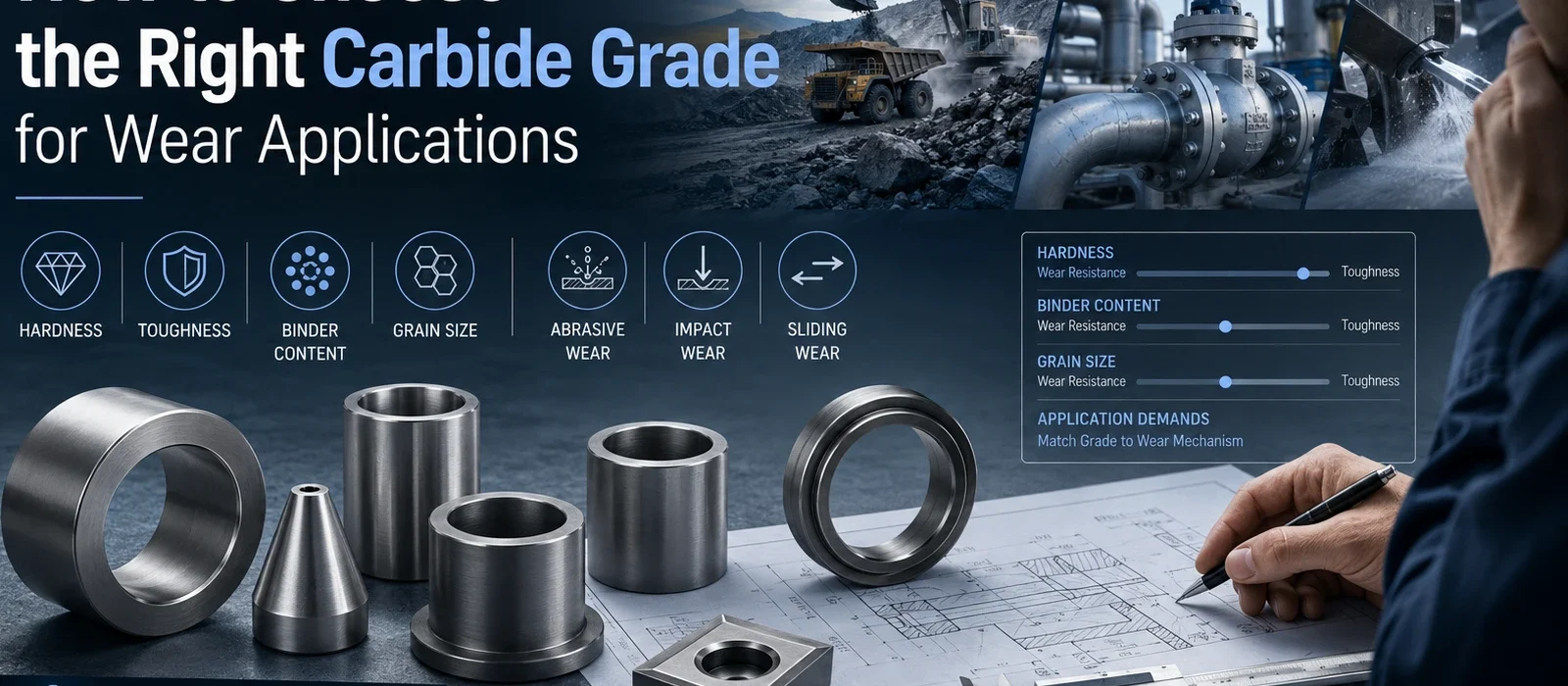
Selecting the right carbide grade is one of the most important decisions in a wear-part project. Two parts may look similar on a drawing, but their working conditions can require very different carbide grades. A grade that performs well in dry abrasion may not be the best option for impact loading, sealing surfaces, corrosive media, or high-speed sliding wear.
For overseas B2B buyers, the goal is not simply to ask for the “hardest” carbide. The better approach is to match hardness, toughness, binder system, grain size, surface finish, and geometry to the real application. This article explains the main factors engineers and sourcing teams should review before confirming a carbide grade.
Start With the Wear Mechanism
The first step is to understand what type of wear the part will face. Abrasive wear occurs when hard particles such as sand, powder, ore, or slurry remove material from the component surface. Erosive wear occurs when particles move at speed through fluid or gas flow, often affecting nozzles, valve seats, and flow-control parts. Sliding wear occurs when two surfaces move against each other under load.
Impact wear is different. In mining, tooling, or heavy machinery, the component may receive repeated shocks. In this case, a very hard but low-toughness carbide may chip or crack. The correct grade must handle both wear and mechanical stress.
Understand Binder Content
Cemented carbide uses a binder metal to hold tungsten carbide grains together. Cobalt is common, while nickel-bonded grades may be considered for some corrosion-related applications. Binder content has a strong influence on hardness and toughness.
In general, lower binder content can provide higher hardness and better abrasive wear resistance. Higher binder content can improve toughness and impact resistance. However, the exact performance also depends on grain size, density, manufacturing control, and the shape of the part. Buyers should avoid selecting grade only by one number.
Consider Carbide Grain Size
Grain size is another key factor. Fine-grain and ultra-fine-grain carbides are often used where high hardness, edge strength, or fine surface finish are important. Medium and coarse grain grades may be suitable where toughness, thermal shock resistance, or impact tolerance is needed.
For cutting tools, fine microstructure can support sharper edges. For mining or heavy wear components, a tougher grade may be preferred. For bushings, sleeves, and seal rings, the decision may depend on the balance between wear resistance, finish, and operating pressure.
Match Grade to Product Geometry
The same grade can behave differently depending on geometry. Thin walls, sharp corners, deep slots, small holes, or unsupported edges can increase stress concentration. A part with a large contact area may tolerate a harder grade, while a part with fragile features may need a tougher grade or a design adjustment.
Before production, it is useful to review whether edges need chamfers, whether the component needs a steel holder, and how the part will be assembled. For press-fit, brazed, or clamped components, mounting stress should be considered together with the grade.
Review Surface Finish and Tolerance
Carbide grade selection is closely connected with finishing requirements. Seal faces, bushings, sleeves, nozzles, and precision wear parts may require grinding, lapping, or polishing. A high-quality finish can reduce friction, improve sealing, and help the component work smoothly with mating parts.
Tolerances should be defined according to function. Very tight tolerances are possible in many carbide parts, but they can increase processing time. Buyers should provide critical dimensions, fit requirements, surface roughness, and inspection standards instead of applying tight tolerance to every dimension.
Application Information Buyers Should Provide
Suppliers can make better grade recommendations when the buyer provides enough background. Important details include working media, temperature, impact level, sliding speed, load, mating material, lubrication, expected service life, failure mode of the current part, and whether the part is used in continuous or intermittent operation.
If the current grade is known, it should be shared. If not, a used sample, photos of worn surfaces, and basic equipment information can still help. For new projects, a drawing with material notes and application description is often enough to start a technical review.
Plan for Trial Production and Feedback
For many wear applications, the first order should be treated as technical validation rather than only a purchasing transaction. A small production batch can confirm whether the selected grade, dimensions, surface finish, and installation method are suitable. After the parts are tested in the real machine, the buyer can share wear photos, service hours, and any assembly feedback.
This feedback is valuable because carbide performance is highly application-specific. If the part shows uniform wear, the grade may be close to correct. If the part chips at edges, the design may need a chamfer, radius, tougher grade, or better support. If wear is concentrated in one area, the equipment alignment or flow path may need review. This practical loop helps reduce long-term risk before larger-volume production.
Grade selection often depends on the product family and service condition; compare carbide wear parts, carbide bushings and sleeves, and wear demands in mining applications before confirming a trial grade.
FAQ
Should I choose the hardest carbide grade available?
Not always. High hardness is useful for abrasion, but impact, bending stress, and fragile geometry may require a tougher grade.
Can one carbide grade be used for all wear parts?
No. Bushings, valve seats, mining inserts, dies, and wear plates may need different grade balances depending on their working conditions.
What if I do not know the current carbide grade?
You can still provide drawings, samples, photos, application details, and failure information. A supplier can use that information to recommend a practical starting grade.
For a carbide grade recommendation, send your drawing, sample details, operating conditions, required tolerance, and expected production quantity. KENIN Carbide can review the application and suggest suitable grade options for testing and production.