How to Read a Tungsten Carbide Grade Chart
A Complete Guide to Carbide Grades, Material Properties and Industrial Applications
14 min read · Technical guide
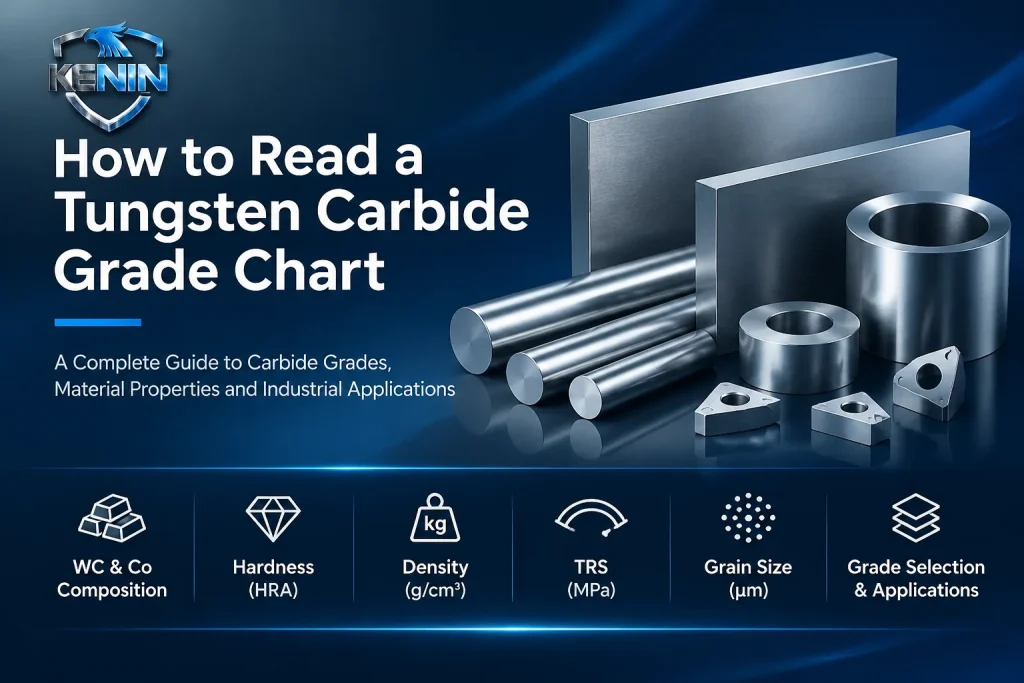
Tungsten carbide is widely used in industrial manufacturing because of its high hardness, excellent wear resistance, and ability to withstand demanding operating conditions.
However, selecting the right tungsten carbide grade requires more than looking at a material designation. Different grades are developed for different applications, and their composition, grain structure, hardness, density, and mechanical properties can vary significantly.
A tungsten carbide grade chart provides essential information for comparing these materials. It helps engineers, manufacturers, and procurement professionals understand material specifications and identify suitable grades for cutting tools, wear-resistant components, dies, mining tools, and other industrial applications.
In this guide, KENIN Carbide explains how to read a tungsten carbide grade chart, understand its key technical parameters, and evaluate different carbide grades according to their intended applications.
We also introduce KENIN's carbide grade range across eight major industrial product categories.
1. What Is a Tungsten Carbide Grade Chart?
A tungsten carbide grade chart is a technical reference table that presents the material composition, physical properties, mechanical characteristics, and typical applications of different cemented carbide grades.
Most conventional cemented tungsten carbide materials consist primarily of tungsten carbide (WC) particles bonded together by a metallic binder, commonly cobalt (Co).
By adjusting the binder content, WC grain size, and material microstructure, manufacturers can develop carbide grades with different combinations of hardness, strength, toughness, and wear resistance.
A typical tungsten carbide grade chart includes:
| Parameter | Description |
|---|---|
| Grade | Material designation |
| ISO Application Group | Indicative cutting-material application classification, where applicable |
| Cobalt Content (Co%) | Nominal cobalt binder content by weight |
| WC Content (%) | Tungsten carbide content by weight |
| Grain Size (μm) | Tungsten carbide grain size or classification |
| Density (g/cm³) | Material mass per unit volume |
| Hardness (HRA) | Resistance to indentation |
| TRS (MPa) | Transverse rupture strength |
| Typical Applications | Recommended or common industrial uses |
These parameters help users compare materials and understand their potential suitability for specific applications.
It is important to remember that a grade chart is a material selection reference. Final grade selection should consider actual operating conditions, component geometry, and manufacturing requirements.
2. Understanding WC and Co
The composition of cemented tungsten carbide is one of the most important factors influencing its mechanical properties.
Tungsten Carbide (WC)
Tungsten carbide is the hard phase in cemented carbide.
It provides:
- High hardness
- Excellent abrasive wear resistance
- High compressive strength
- Good resistance to mechanical surface wear
- Dimensional stability under suitable operating conditions
WC grain size also influences the material's hardness, strength, and wear behavior.
Cobalt (Co)
Cobalt is commonly used as the metallic binder in WC-Co cemented carbide.
It holds the tungsten carbide grains together and contributes to the material's toughness.
In general:
- Lower cobalt content tends to increase hardness and abrasive wear resistance.
- Higher cobalt content generally improves toughness and resistance to impact-related damage.
- Higher binder content usually reduces hardness in comparable material systems.
These are general trends rather than universal rules. Grain size, carbon balance, additional carbides, and manufacturing processes also influence the final properties.
Understanding WC and Co Percentages
For a simple binary WC-Co system, the WC and Co percentages add up to approximately 100%.
For example:
| Conventional Grade | Co Content | WC Content |
|---|---|---|
| YG6 | 6% | 94% |
| YG8 | 8% | 92% |
| YG10 | 10% | 90% |
| YG15 | 15% | 85% |
| YG20 | 20% | 80% |
These examples explain conventional YG designations. Other KENIN grade families use their own grade codes and material specifications.
3. Understanding Grade Designations
Carbide manufacturers use different grade designation systems depending on material composition, product category, manufacturing requirements, and internal grade specifications.
Some grades use conventional designations such as YG6, YG8, and YG15. Others use manufacturer-specific codes to identify material formulations designed for particular products and applications.
For example, KENIN's grade system includes:
| Grade Family | Representative Grades | Main Product Applications |
|---|---|---|
| KCU / KU | KCU20, KCU092, KU25UF, KU10UF | Tungsten carbide rods |
| YG | YG6, YG8, YG15, YG20 | Custom tungsten carbide wear parts |
| KGR | KGR20, KGR30, KGR40, KGR45, KGR55, KGR60 | Carbide roll rings |
| KK | KK06, KK10, KK11 | Carbide mining tools |
| KCG / KCA / KCT | KCG5, KCG6, KCA18, KCA24, KCT15, KCT20, KCA20 | Cold heading dies and forming tools |
| KS | KS09U, KS12UF, KS10ST | Cemented carbide gear cutting tools |
| KS / KSG | KS50H, KS30H, KSGU10, KSGK05A | Oil and gas carbide components |
| KS | KS02UCR, KS06CR, KS08CR | Woodworking and panel processing |
Important: Not every grade designation directly indicates cobalt content or grain size. Manufacturer-specific codes must be interpreted using the corresponding technical specifications.
When comparing materials from different suppliers, always check the actual composition and mechanical properties rather than relying on the grade name alone.
4. Key Parameters in a Grade Chart
Understanding the technical parameters is essential when evaluating different carbide materials.
4.1 Cobalt Content (Co%)
Cobalt content represents the nominal percentage of cobalt binder by weight.
It is one of the main factors influencing the hardness-toughness balance.
Generally:
- Lower Co content is associated with higher hardness and abrasive wear resistance.
- Higher Co content generally provides greater toughness and impact resistance.
The appropriate binder content depends on the application, grain structure, and required mechanical properties.
4.2 Tungsten Carbide Content (WC%)
WC content indicates the proportion of tungsten carbide in the material.
In a simple binary WC-Co system, WC and Co percentages add up to approximately 100%.
For more complex carbide compositions, additional carbides or other constituents may also be present.
4.3 Density (g/cm³)
Density is the mass of a material per unit volume, commonly expressed in grams per cubic centimeter.
It is influenced by the material composition and microstructure.
Density is useful for:
- Material consistency checks
- Quality control
- Composition verification
- Component weight calculations
- Identifying potential material variations
Density should be evaluated together with other technical parameters rather than used as the sole indicator of material quality.
4.4 Hardness (HRA)
Hardness measures the material's resistance to localized indentation.
Tungsten carbide hardness is commonly measured using the Rockwell A scale (HRA). Vickers hardness (HV) is another commonly used measurement method.
Higher hardness generally contributes to better resistance to indentation and abrasive wear.
However, hardness alone cannot determine the overall performance of a carbide component.
A grade with higher hardness may not be the best choice for applications involving severe impact or mechanical shock.
4.5 Transverse Rupture Strength (TRS)
Transverse rupture strength measures the bending strength of a cemented carbide specimen under specified test conditions.
It is generally expressed in MPa or N/mm².
TRS is important when evaluating materials subjected to bending stresses or mechanical loading.
A higher TRS value indicates greater bending strength under comparable test conditions.
However, TRS is not identical to fracture toughness and should not be interpreted as a direct measurement of impact resistance.
4.6 Tungsten Carbide Grain Size
Grain size refers to the size of tungsten carbide particles in the material's microstructure.
Common classifications include:
- Nano grain
- Ultrafine grain
- Submicron grain
- Fine grain
- Medium grain
- Coarse grain
- Extra-coarse grain
In general, finer grains can provide higher hardness and improved abrasive wear resistance.
Coarser grain structures may offer different toughness characteristics depending on the binder content and overall material design.
Two carbide grades with similar cobalt content can still have different mechanical properties because of differences in grain structure.
5. ISO Carbide Classification
ISO classification is another parameter that may appear in a carbide grade chart.
For cutting tool materials, ISO 513 identifies several major application groups.
| ISO Group | General Application | Typical Workpiece Materials |
|---|---|---|
| P | Steel machining | Carbon steel and alloy steel |
| M | Stainless steel machining | Stainless steel |
| K | Cast iron machining | Gray cast iron and other cast irons |
| N | Non-ferrous material machining | Aluminum, copper and non-ferrous alloys |
| S | Heat-resistant and difficult-to-machine materials | Titanium alloys and heat-resistant alloys |
| H | Hardened material machining | Hardened steel and other hardened materials |
These classifications help identify the intended machining applications of cutting tool materials.
Important distinction: ISO application classifications are not direct equivalents of material grade designations.
For example, YG8 is a conventional WC-Co material designation, whereas ISO K20 identifies a position within a cutting-material application classification.
ISO groups should not be treated as universal classifications for every tungsten carbide wear part, die, mining component, or industrial product.
Some KENIN grade entries do not have an ISO application group specified. These entries should remain unassigned unless their technical classification has been verified.
6. KENIN Carbide Grades
KENIN's carbide grade reference covers 34 grade entries across eight major product categories.
Each category contains materials designed for different manufacturing processes and operating conditions.
6.1 Tungsten Carbide Rods
Representative grades:
- KCU20
- KCU092
- KU25UF
- KU10UF
These grades are used for manufacturing solid carbide cutting tool blanks and precision machining components.
Typical applications include:
- Solid carbide end mill blanks
- Drill blanks
- Micro-drill blanks
- High-speed drilling tools
- Precision machining tools
The material selection depends on workpiece material, cutting speed, machining conditions, and required tool performance.
6.2 Custom Tungsten Carbide Wear Parts
Representative grades:
- YG6
- YG8
- YG15
- YG20
These grades are used in different wear-resistant and mechanical applications.
Typical products include:
- Tungsten carbide wear plates
- Wear blocks
- Carbide liners
- Saw tips
- Wear-resistant nozzles
- Custom-shaped carbide components
The appropriate material depends on the balance between abrasive wear resistance, toughness, and mechanical loading.
6.3 Carbide Roll Rings for the Steel Industry
Representative grades:
- KGR20
- KGR30
- KGR40
- KGR45
- KGR55
- KGR60
These grades are designed for carbide roll rings used in wire rod and steel bar rolling mills.
Typical applications include:
- Finishing mill roll rings
- Reducing and sizing stands
- Pre-finishing mill roll rings
- Intermediate rolling mill components
- Steel bar and wire rod rolling
Different rolling stands have different operating conditions, including rolling loads, speeds, temperatures, and wear requirements.
Grade selection should consider the specific rolling process and mill configuration.
6.4 Carbide Mining Tools
Representative grades:
- KK06
- KK10
- KK11
These grades are used in tungsten carbide mining inserts and buttons.
Typical applications include:
- Down-the-hole (DTH) drill bits
- Tricone drill bits
- Cone bit inserts
- Reamer bits
- Rock drilling tools
The material requirements depend on rock hardness, drilling conditions, impact loading, and wear mechanisms.
6.5 Cold Heading Dies and Forming Tools
Representative grades:
- KCG5
- KCG6
- KCA18
- KCA24
- KCT15
- KCT20
- KCA20
These grades are designed for carbide dies and tooling used in metal forming and fastener manufacturing.
Typical applications include:
- Cold heading dies
- Screw heading dies
- Bolt forming dies
- Fastener production tooling
- Stamping and forming dies
- Precision carbide die inserts
These applications require careful consideration of toughness, strength, die geometry, and repeated mechanical loading.
6.6 Cemented Carbide Gear Cutting Tools
Representative grades:
- KS09U
- KS12UF
- KS10ST
These materials are used for cemented carbide gear cutting tool blanks and related precision tooling.
Material selection depends on the cutting process, tool geometry, workpiece material, and required tool performance.
6.7 Oil and Gas Tungsten Carbide Components
Representative grades:
- KS50H
- KS30H
- KSGU10
- KSGK05A
These grades are designed for demanding oil and gas applications.
Typical components include:
- Carbide valve seats
- Choke components
- Flow-control components
- Wear-resistant inserts
- Downhole carbide components
The material selection should consider abrasion, erosion, pressure, impact, fluid compatibility, and operating conditions.
6.8 Woodworking and Panel Processing
Representative grades:
- KS02UCR
- KS06CR
- KS08CR
These grades are used for woodworking and panel-processing tools.
Typical applications include:
- Woodworking cutting tools
- Panel processing tools
- Precision cutting components
- Industrial woodworking tooling
The appropriate grade depends on the material being processed, cutting conditions, tool design, and required edge performance.
Explore the existing KENIN Tungsten Carbide Grades database to search and compare grade entries. Material properties and grade recommendations are provided for preliminary reference. Please contact KENIN to confirm specifications and grade suitability for your application.
7. Comparing Different Grades
When comparing carbide grades, do not focus on a single parameter.
A reliable comparison should consider:
| Factor | What to Compare |
|---|---|
| Material composition | WC and binder content |
| Density | g/cm³ |
| Hardness | HRA or HV |
| TRS | MPa or N/mm² |
| Grain size | μm or grain classification |
| Application | Actual working conditions |
| Manufacturing requirements | Dimensions, tolerances and surface finish |
For example, two grades may have similar hardness values but different TRS values or grain structures.
Likewise, materials with similar binder content may have different wear characteristics because of their microstructure and manufacturing processes.
The best grade is the one that provides the required balance of properties for the actual application.
8. Selecting Grades for Industrial Applications
Start with the component’s operating conditions and the dominant damage mechanism. A grade for steady abrasive wear may need a different balance of properties from a grade exposed to impact, bending or repeated thermal changes.
For machining tools, specify the workpiece material and cutting process. For forming dies, describe the work material, loading cycle and supporting assembly. For flow-control parts, describe the fluid, solids, temperature and pressure. Compare candidate grades with the manufacturer using the complete specification and representative application testing.
KENIN Carbide Material and Manufacturing Solutions
KENIN Carbide supplies tungsten carbide materials and customized cemented carbide components for industrial manufacturing customers.
Our product range includes:
- Tungsten carbide rods
- Tungsten carbide plates
- Carbide dies and tooling
- Carbide roll rings
- Carbide mining tools
- Gear cutting tool blanks
- Oil and gas carbide components
- Custom tungsten carbide wear parts
We support material evaluation and drawing-based manufacturing for customers with specific dimensional, mechanical, and application requirements.
Whether you need standard carbide blanks or customized industrial wear components, material selection should always be based on the actual operating conditions and technical specifications.
9. What to Request from a Manufacturer
When purchasing tungsten carbide materials or custom carbide components, a grade designation alone may not provide enough information.
We recommend requesting:
Material specifications
- Complete grade designation
- Binder type and nominal content
- WC content or complete material composition
- Grain size
- Density
- Hardness
- TRS
Product specifications
- Product dimensions
- Dimensional tolerances
- Surface condition
- Machining allowance
- Available blank sizes
- Inspection requirements
Application information
- Working environment
- Abrasive or corrosive media
- Mechanical loading
- Impact conditions
- Operating temperature
- Expected service requirements
For customized components, provide a technical drawing or physical sample whenever possible.
This allows the manufacturer to evaluate the material and manufacturing requirements more accurately.
Explore Related Products
10. FAQ
1. What is a tungsten carbide grade chart?
A tungsten carbide grade chart is a technical reference that compares material grades according to composition, density, hardness, TRS, grain size, and typical applications.
2. What does YG8 mean in tungsten carbide?
YG8 is a conventional WC-Co cemented carbide designation with approximately 8% nominal cobalt content by weight and approximately 92% WC in a simple binary system.
3. Are all tungsten carbide grade codes based on cobalt content?
No. Some conventional designations indicate nominal binder content, while many manufacturer-specific grade codes identify proprietary or application-oriented material formulations.
4. What is the difference between HRA and TRS?
HRA measures resistance to indentation, while TRS measures bending strength under specified test conditions. They describe different mechanical properties.
5. Does higher hardness always mean better wear resistance?
Not necessarily. Wear performance depends on the wear mechanism, grain structure, binder content, operating conditions, and component design.
6. What does ISO K20 mean in a carbide grade chart?
ISO K20 is a cutting-material application classification associated with cast iron machining. It is not a direct chemical composition or universal material grade designation.
7. How do I choose the right tungsten carbide grade?
Consider the working environment, abrasive wear, impact loading, mechanical stresses, product geometry, and required material properties. A carbide manufacturer's technical team can help evaluate suitable materials.
8. Can KENIN supply customized tungsten carbide materials and components?
Yes. KENIN supports tungsten carbide material supply and customized component manufacturing according to customer drawings, samples, and technical requirements.
Conclusion
Understanding how to read a tungsten carbide grade chart helps engineers and procurement professionals make more informed material decisions.
The key parameters include cobalt content, WC content, density, hardness, transverse rupture strength, and grain size. Each provides different information about material performance and should be evaluated together.
KENIN's grade reference covers 34 carbide grade entries across eight industrial product categories, including carbide rods, wear parts, roll rings, mining tools, cold heading dies, gear cutting tools, oil and gas components, and woodworking applications.
For reliable material selection, compare the complete technical specifications and consider the actual working conditions rather than relying only on a grade designation.
Looking for a suitable tungsten carbide grade for your application?
Send KENIN Carbide your required material specifications, product drawing, or application details.
Our team can review your requirements and help evaluate a suitable carbide material and manufacturing solution.
Contact KENIN Carbide for technical support and a quotation.