Carbide Valve Seats and Nozzles for Oil & Gas Applications
Oil and gas equipment often operates in abrasive and high-pressure environments. Flow-control components such as valve seats, nozzles, choke parts, and sealing elements may be exposed to sand, drilling fluids, slurry, pressure changes, and erosive flow. Tungsten carbide is widely used in these applications because it can resist wear and help maintain working geometry longer than many conventional materials.
For industrial buyers, carbide valve seats and nozzles are usually not simple commodity parts. Their performance depends on carbide grade, geometry, surface finish, tolerance, sealing design, and the way they are assembled into the equipment. Clear technical requirements are essential for successful sourcing.
Why Valve Seats and Nozzles Face Severe Wear
Valve seats and nozzles are located where flow direction, pressure, or speed may change. When abrasive particles are present, these areas can suffer erosion and localized wear. If the sealing surface loses its geometry, the system may experience leakage, unstable control, reduced efficiency, or early maintenance.
In oil and gas service, wear is rarely caused by one factor only. Sand content, particle size, fluid chemistry, pressure, temperature, flow velocity, and operating cycles all influence component life. This is why material selection and design review should be done together.
Advantages of Tungsten Carbide in Flow-Control Components
Tungsten carbide offers high hardness, strong abrasion resistance, and good compressive strength. These properties make it suitable for components that must keep a precise edge, bore, or sealing face under erosive conditions. Carbide can also be ground and polished to create accurate surfaces for sealing and controlled flow.
For nozzles, wear resistance helps maintain bore size and flow pattern. For valve seats, dimensional accuracy and surface finish help support sealing performance. For choke and flow-control parts, carbide can reduce erosion at high-wear locations.
Grade Selection for Oil and Gas Parts
Grade selection should consider both wear and toughness. A harder grade may perform well against erosion, but a tougher grade may be needed if the component faces impact, thermal change, or assembly stress. In some environments, binder choice may also be reviewed due to corrosion concerns.
Buyers should provide information about media, pressure, temperature, particle content, mating parts, and previous failure mode. If the part is used in a critical sealing function, surface finish and inspection method should also be clearly defined.
Important Design Details
Valve seats and nozzles often include bores, tapers, sealing faces, grooves, chamfers, and precision outer diameters. Small design details can have a large effect on performance. Sharp edges may need controlled radius or chamfer to reduce chipping. Unsupported thin sections should be reviewed for risk during assembly or operation.
If the carbide part is brazed, pressed, or inserted into a steel body, the fit and thermal conditions should be considered. Assembly stress can damage carbide if the design is not suitable. Proper support helps carbide perform as intended.
Inspection Requirements
Because valve seats and nozzles are precision components, inspection should cover dimensions, bore accuracy, surface condition, edge quality, and visual defects. For sealing faces, surface finish may be critical. For nozzles, bore geometry and consistency can affect flow behavior.
A practical drawing should identify critical dimensions separately from general dimensions. This helps the supplier focus machining and inspection resources where they matter most.
For repeat orders, buyers may also define a simple control plan. This can include checking critical bore dimensions, sealing face condition, outer diameter fit, and visual edge quality. The goal is not to make documentation complicated, but to make sure every shipment matches the function of the component. Consistent inspection requirements are especially useful when the same part is used in several tool assemblies or shipped to different maintenance locations.
Packaging is another practical issue for carbide valve seats and nozzles. Precision sealing faces and small bores should be protected from scratches, dust, and edge impact. If parts are cleaned before assembly, buyers should specify whether oil-free packing, individual boxes, or special labeling is required.
When a buyer is replacing an existing seat or nozzle, the most useful feedback is often the worn part itself. Erosion around the bore, scratches on the sealing face, or chipped edges can show whether the main issue is flow velocity, abrasive media, misalignment, assembly stress, or an unsuitable grade. This information helps the supplier recommend practical changes instead of simply copying a design that may already have a known weakness.
Information Buyers Should Provide
To request carbide valve seats or nozzles, buyers should send a drawing, material or grade requirement if known, working media, pressure and temperature range, annual quantity, and any inspection standard. If the current part is failing, photos of worn surfaces can help identify erosion, cracking, corrosion, or assembly-related issues.
For custom nozzles, bore size, shape, flow direction, inlet and outlet geometry, and surface finish should be clear. For valve seats, sealing face angle, contact surface, matching component, and fit tolerance are important.
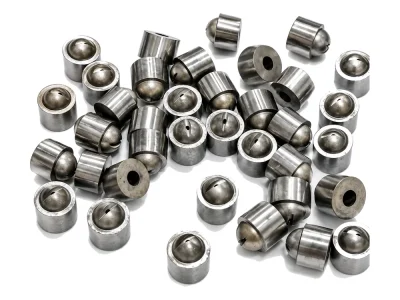
Buyers comparing flow-control components can review carbide valve seats and nozzles, the carbide nozzle sample product, and the broader oil and gas application page.
FAQ
Why use carbide for oil and gas valve seats?
Carbide can resist abrasive and erosive wear, helping maintain sealing geometry and service life in demanding flow-control applications.
Can carbide nozzles be made with small precision bores?
Yes. Precision bores can be produced, but size, tolerance, shape, finish, and inspection requirements should be clearly defined on the drawing.
Do all oil and gas parts use the same carbide grade?
No. Grade choice depends on wear mechanism, impact level, corrosion concerns, geometry, and assembly method.
If you are sourcing carbide valve seats, nozzles, or flow-control components, send drawings, samples, operating conditions, and technical requirements. KENIN Carbide can review the design and support custom carbide production for oil and gas applications.